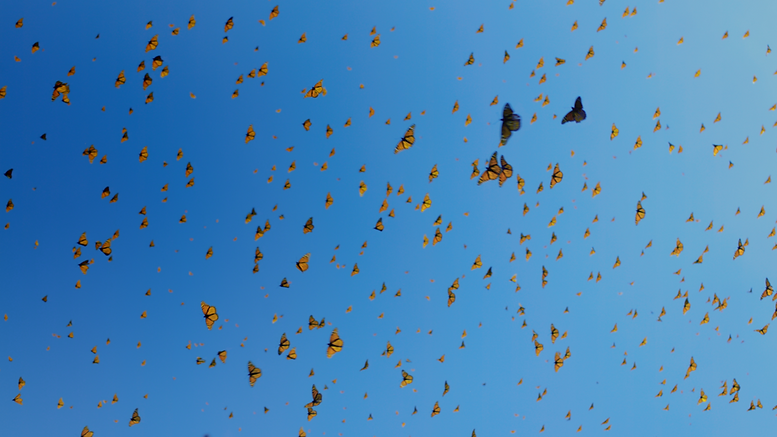
More than just a film, VOIR L'AUTOMNE is an awareness-raising tool that has the potential to educate, amaze and awaken people's consciousness to the abundant life that appears during this season.
Knowledge and emotion being the basis of all action, the film and its educational resources will be available for you to take further, at any age, your discovery of autumn, after its broadcast on 21 October 2025 at 9:10 p.m. on France 2.
Organise a screening
Organise a screening in
my NGO
my school
my association
VOIR L'AUTOMNE is made available for free to schools, associations, NGOs and any non-commercial initiative that wishes to organize an independent screening. Only free public screenings are authorized.
1
Define your educational program around the film VOIR L'AUTOMNE and this season in France.
You can use the dedicated educational file (French only), as well as our other freely-available resources (French only) for taking action.
To host your screening, consult our list of contributors (French only) : characters appearing in the movie or a partner association.
2
Register your screening project by filling in the quick, and dedicated form (French only).
You will then receive a confirmation e-mail with the links to view the film. You'll have access to the whole film, as well as to two parts.
Corporate screenings are subject to a specific procedure. Tell us about your screening project at developpement@hopeprod.com.
Organise an event around the film
To animate the film screening, you can contact a naturalist who took part in the film or a specialized association for an educational intervention.
Partner
associations
They will be able to talk about their field of expertise and ecological issues more generally. Many of them also offer other biodiversity-related educational resources, and will be delighted to share them with you.
Characters of the movie
They will be able to talk about the regions and species they came across in the movie or that they meet on a daily basis, their passion as nature enthousiast, and the challenges of nature conservation in general for some of them.
Discovering nature
Explore natural spaces through the film
Rediscover the film's images and species across the different natural spaces by clicking on the photos below! You will also find the names of the videographers who captured each image.


The little observer's guide
As nature lovers, we like to observe, and this is an essential step in generating the desire to preserve and protect the living world around us. But observing requires good practices and precaution to avoid disturbing ecosystems. To be as discreet as possible, there are a few simple rules to apply at any age, and to pass on to the younger ones.
1
Observer la vie sauvage n’implique pas nécessairement d’aller au bout du monde.
Nommer les plantes sur votre trajet quotidien, découvrir l’exotisme des parcs et jardins de votre région, identifier le chant des oiseaux à votre fenêtre, redécouvrir les espèces qui colonisent les cours d’eau et les bois de nos régions, l’émerveillement est à portée de main partout, tout le temps, pour tous les âges !
2
Prendre le temps.
La patience sera le maître mot de vos sorties naturalistes. L’apparition des animaux dans l’axe des jumelles ne se commande pas ! Prenez le temps de bien préparer vos sorties, d’identifier les passages les plus prometteurs, de vous équiper chaudement au besoin et d’emporter de quoi préparer une attente confortable. Ou au contraire partez le nez au vent en profitant ce que la nature vous offrira spontanément sur votre chemin ! Certains animaux s’entrevoient seulement l’espace de quelques secondes au détour d’un chemin. Mais l’observation peut aussi être un jeu de patience : planter quelques graines dans un pot en classe, observer jour après jour la croissance d’une fougère, laisser un carré de pelouse revenir à l’état sauvage, etc.
3
Le silence est d’or.
Pour approcher les animaux les plus farouches, la discrétion est de mise. En vous déplaçant silencieusement vous augmenterez vos chances de les apercevoir. Vous ne perturberez pas non plus toutes les espèces dont vous ne soupçonnez même pas la présence mais qui vous ont pourtant entendu approcher de très loin. A proximité des animaux, parlez doucement et ne faites pas de mouvements brusques pour ne pas les alarmer.
4
Garder ses distances.
Avec le silence et la patience, la gestion de la distance est l’autre clé pour observer la nature. Approchez les animaux en les contournant plutôt qu’en vous dirigeant frontalement vers eux pour ne pas les stresser ni provoquer de comportement défensif. Utilisezdes jumelles et stoppez toute approche au moindre signe d’inquiétude ou d’éloignement. La distance à respecter peut varier selon les espèces et les individus mais aussi des saisons (pendant la période de reproduction par exemple), renseignez-vous bien avant de partir.
5
Ne laisser aucune trace de son passage
Si vous restez des heures à l’affût, laissez l’endroit complètement propre et sans traces de votre passage pour ne rien perturber. Et si en chemin des déchets jonchent votre route, ayez la gentillesse de les emporter avec vous. Ne laissez rien à manger aux animaux non plus. Vous pourriez malgré vous leur créer des problèmes de santé, modifier leur comportement ou créer des habitudes néfastes envers les promeneurs.
6
Toucher avec les yeux !
Pour préserver les espèces, pour votre santé et votre sécurité, ne prélevez rien sans certitude absolue et ne touchez jamais aucun animal. Prendre de petits animaux comme des crustacés ou des insectes même si ce n’est que pour les observer dans un seau pourrait leur être fatal. Toucher un nid pour voir s’il abrite des œufs peut subtilement perturber l’agencement de la végétation autour, ce qui peut gêner le retour des parents ou donner accès aux prédateurs. N’approchez jamais un jeune animal : c’est bien connu il est rarement seul et la mère n’est pas loin. Pour la cueillette des végétaux ou des champignons, renseignez-vous au préalable sur les lieux autorisés et ne prenez jamais le risque de cueillir – encore moins de goûter – ce que vous ne connaissez pas.
7
Observer avec ses 5 sens
Ne passez pas à côté du spectacle complet de la nature en vous basant uniquement sur votre vue. L’observation passe par les 5 sens :appréciez la vie sous toutes ses nuances de formes et de couleurs selon les saisons, touchez la texture d’une feuille ou d’un tronc, sentez l’odeur de l’humus en forêt ou de l’air marin sur le littoral, savourez – sur les conseils d’un expert – le goût des plantes sauvages aromatiques, écoutez le chant des oiseaux mais soyez également a l’affût du moindre craquement de branche ou… du silence.
8
Laisser libre cours à sa créativité.
Pour les artistes ou les plus manuels, essayez-vous au land art en créant œuvres et instruments de musique depuis des matériaux naturels, ou essayez-vous simplement au dessin ou la lecture en pleine nature.
9
Enfin (et avant tout), se renseigner
Bien préparer son expédition, quelle que soit son envergure, est la garantie d’un bon moment en pleine nature. Les associations, les offices de tourisme et les différentes institutions vous donneront toutes les informations pratiques, légales ou scientifiques dont vous pourriez avoir besoin. Pensez à bien préparer votre trajet, à vous renseigner sur la réglementation, les périodes de reproduction, les zones de nidification et les frayères, etc.
Les guides locaux et les associations sauront aussi vous faire profiter de leur expérience pour une exploration inoubliable.
OBSERVE NATURE
THE GOLDEN RULES
Get involved every day
6 WAYS TO
1
Je limite ma consommation de viande.
2
Je protége les espèces en voie d'extinction en limitant la chasse.
3
Je laisse un coin en friche dans mon jardin en évitant de tondre.
4
Je mange bio pour diminuer les pesticides, si j'en ai les moyens.
5
Je plante des haies, des arbres et des fleurs pour aider la pollinisation.
6
Je rejoins une association de préservation de la biodiversité.
Resources for action
With my convictions and my will, as a family or with friends, at home or in nature, in my school or in my town, I'm committed to the living world around me!
The director
of associations
To take things a step further, we suggest you to get in touch with some of our partner associations to benefit from their specific resources. You can also contact them now to get involved and take action.
Jane Goodall Institute France
Roots & Shoots is the environmental education program for and by young people of the Jane Goodall Institute France. Roots & Shoots members gather in small groups around a common project to raise awareness and take local action in environmental education and protection, on humanitarian and civic engagement topics they choose or are proposed by the Jane Goodall Institute France. Supported by the entire Roots & Shoots network and guided by adults in classrooms, schools, MJCs, social centers, etc., Roots & Shoots projects and their achievements can be integrated into the school curriculum.

janegoodall.fr
janegoodall.fr


Fondation GoodPlanet
The GoodPlanet Foundation has launched CAP 2030, a national program to raise awareness and mobilize 15-25 year-olds around the major issues of combating climate change, protecting biodiversity and promoting social justice. By identifying concrete avenues for action, the program enables young people to grasp current ecological and solidarity issues in the light of the United Nations' Sustainable Development Goals (SDGs), and to respond to them at local level.
Fondation pour la Nature et pour l'Homme
Plant to help biodiversity, but also for everyone's health and well-being. That's what the #JagisJePlante campaign is all about, with free training from the Fondation pour la Nature et pour l'Homme on how to plant country hedges, green walls, edible groves and mini urban forests.

goodplanet.org
goodplanet.org

fnh.org
fnh.org
Ligue pour la Protection des Oiseaux – LPO
Through its educational activities, the LPO aims to contribute to the understanding of ecosystems, to highlight their fragility and to raise awareness of biodiversity in order to influence behavior and develop responsible attitudes that respect living things. With its bird counts, wildlife observation, refuges, national campaigns and educational documentation, the LPO is as much an institution as it is a goldmine for action on behalf of biodiversity.

lpo.fr
lpo.fr
Fond Mondial pour la Nature – WWF
WWF works to conserve some 50 endangered species on every continent. They are of ecological, economic and cultural importance, and require concerted conservation efforts at both global and local levels. The WWF network is active in 35 marine and terrestrial ecoregions, with some of the richest, rarest and often threatened natural heritage on the planet. WWF works to develop human activities that respect the planet and its biodiversity.

wwf.fr
wwf.fr
France Nature Environnement
As a federation, FNE supports its member and affiliated associations in their actions and works to develop and recognize environmental education. The 9,000 local and national associations federated by France Nature Environnement have always been committed to raising environmental awareness in all regions of France, and offer a wide range of educational content, training courses, interventions and more.

fne.asso.fr
fne.asso.fr
Fondation Tara Océan
France's first charitable foundation dedicated to the ocean, the Tara Ocean Foundation is developing an open, innovative and unprecedented ocean science that will enable us tomorrow to predict, anticipate and better understand climate risks and better protect biodiversity. It uses this high-level scientific expertise and these adventures at sea to raise awareness and educate the younger generations and the general public, mobilize political decision-makers at the highest level, and enable developing countries to make use of this new knowledge about the Ocean.

fondationtaraocean.org
fondationtaraocean.org
FERUS
FERUS is the national association dedicated to the protection of large predators in France. For the past 20 years, it has been working to promote the return of the bear, wolf and lynx in all favorable natural environments. It also works actively to promote the cohabitation of large predators and human activities, notably through its flagship PastoraLoup program, which offers additional assistance to farmers in wolf areas. FERUS also offers other field programs in the Alps, Jura, Vosges and Pyrenees to improve knowledge and acceptance of bears, wolves and lynx. In the Pyrenees, the Api'Ours program enables the planting of fruit trees to promote biodiversity. FERUS also takes legal action, participates in meetings with public authorities, gives lectures and speaks in schools.

fondationtaraocean.org